



This article is the first in a two-part series exploring SEO best practices and its evolution. The second article discusses how to leverage AEO to improve in AI search rankings
The massive shift from traditional search engine optimization (SEO) to AI search optimization is requiring every organization to re-evaluate its SEO best practices. AI search is fundamentally rewriting the playbook on how your content gets discovered in 2026. And while it may feel like a leap into the unknown, winning over new algorithms requires establishing new fundamentals, starting with local SEO.
Content marketers and business leaders alike share a common ambition: cracking the code for how to rank higher on Google and other search engines. But marketing professionals across the board are grappling with a new and significant drop in organic traffic tied to AI search, upending finely tuned websites and content strategies everywhere.
Online marketing is undergoing its largest shift in three decades, according to Bain & Company research. Nearly 60% of searches now result in zero clicks because the user never leaves the search page, which isn’t difficult to imagine with nearly a quarter of the page taken up by AI search results.
How should SEO best practices evolve to avoid being buried in AI search results? The answer (in part) is local SEO. To capture visibility today, businesses need to leverage both local SEO and answer engine optimization (AEO). Local search serves as the building blocks, organizing information so “answer engines” can easily digest it.
What is local SEO?
Local SEO refers to the process of optimizing a brand’s visibility or rankings within location-based search results. In other words, optimizing a website to appear more often in a specific geographic region. Think: “best pizza near me,” “pizza nearby,” or “pizza in Grand Rapids, MI.”
When trying to rank in search, most business leaders take the “if you build it, they will come” approach, focusing only on content that describes who they are and what they do. But they overlook the power of local keywords — putting them in competition with everyone. (Talk about a steep hill to climb.) Rather than compete with a sea of undefined national competition, it’s important to optimize your content for your location and provide an efficient path to potential customers that are already nearby.
Why is local SEO important to optimize for AI search?
There are now fewer direct queries, like “pizza,” and more question-based queries, such as “what kind of pizza is near me.” That is to say, people are leaving the old standard of Google search behind and are using AI search programs to ask questions instead. But this style of query isn’t something AI search strategies can address.
Local SEO fills the gap between traditional and AI search that is currently missing — with its inability to search via geographic location unless specifically prompted. By investing in local SEO now, you can future-proof your SEO for when AI search is able to query via geographic location without specific prompting.
To increase the chances of your content being surfaced in an AI overview or coming up as a result within an AI search, your SEO strategies should prioritize local content with question-and-answer-based structure.
How to improve local SEO rankings in 3 steps
There are many ways to improve your local SEO rankings, but the following three steps are the cornerstones of local search best practices.
1. Audit your website for SEO
An SEO audit is a comprehensive health check of your website’s performance, designed to identify opportunities to improve your visibility and rank in search engine results. It allows you to determine whether your content strategy is still working, or if your results took a hard right turn away from your goals six months ago.
An SEO audit helps you step back and look at the big picture of what your entire business is ranking for and the search-engine-perceived direction of your organization’s work. This is where the big picture shows that, while you thought you were aiming for the bullseye, your efforts were actually off the mark.
Solidify what you want to achieve:
- What is your website trying to accomplish?
- What action would you like your audience to take?
Document your findings:
Take the time to document all of your blogs, pages, posts, and all of the keyphrases you believe you’re ranking for in each instance. This document should include:
- URL of each page/post
- Page/post title
- Focus keyphrase for the page/post
- Any related keyphrase synonyms
- Meta description (if you’re using a plugin)
- How many external and internal links are on the page/post
- Categories attached to the page/post
2. Conduct local keyword research and set goals
In the world of SEO, experts use on-topic search terms called keyphrases to help search engines better understand the content on a web page. Evaluate whether your current local keyword strategies are still working and improving your presence in AI search results.
There are a handful of tools that can help you narrow in on the keyphrases AI search is using to find your site. Google Search Console, for example, is a free service that allows you to gain deep insight into how users find content via search. Alternatively, consider using an agency like Brightly to track your target phrases and measure your local keyword rankings.
As you evaluate the results, determine what keywords you want (or need) to rank for, and start to assess your current content against the following considerations:
- Are you targeting the right keywords for your business goals?
- Does your content answer visitors’ questions?
- Is your content demonstrating enough experience, expertise, authority, and trustworthiness?
- Are your titles, tags, meta descriptions, and headings optimized for AI search?
- What needs to change?
3. Create a content plan for local keywords: short-tail to long-tail
Once you determine the type of content you want to publish in alignment with your business goals and target audience, create guidelines for local keywords.
Keyphrases come in three forms: short-tail, mid-tail, and long-tail. The term “tail” comes from the position of the keyphrase on the “search demand” curve seen below.
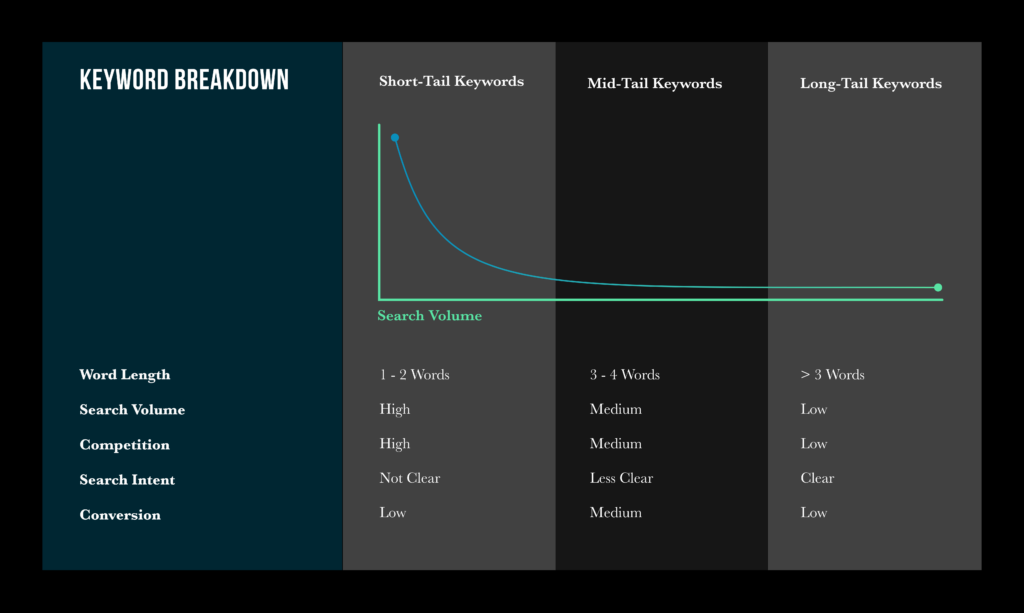
A short-tail keyphrase consists of one-to-two words — like “SEO” — and always has a higher volume of searches. But they come with the downside of existing within a highly competitive space, leading to a lower conversion rate.
A mid-tail keyphrase consists of three-to-four words and bridges the gap between short- and long-tail keyphrases. It allows you to capture a larger volume of searches while also having a middle-of-the-road conversion rate.
Long-tail keyphrases are specific and targeted. They consist of four or more words — like “SEO experts in Grand Rapids, Michigan.” And while they only generate 50-100 queries a month, they do not have to compete as hard and will have a higher conversion rate.
Select your keyphrases strategically. It’s very rare that short-tail keyphrases will help you to meet your goals. Instead, it’s far more effective to use mid-tail and long-tail keyphrases to help customize content for your audience.
Bonus: Consider every channel
Don’t forget that the landscape of search has expanded beyond traditional browsers (just ask Jeeves). Make sure you audit, set goals, and update your business profiles, social media profiles, and popular directories.
It might seem obvious but it’s important to audit the various channels your website is registered to. If you’re going to change anything about these profiles, it is important to make sure that your company’s name, address, and phone number (NAP) is consistent throughout all of your online profiles. Providing consistent and accurate business information helps build trust and credibility, and therefore, verifies a business’s legitimacy. All of these things can influence your local search rankings and visibility.
With all of this in mind, you may be asking yourself, Is it really that important to start optimizing for AI search instead of using tried and true SEO methods? Unlike the changes in SEO best practices of the past, where relatively small changes could realign a business’ SEO strategy to current standards, optimizing for AI search requires a full content shift throughout your entire web presence and is no longer a quick and simple fix.
Reach out to a Brightly SEO specialist to learn how we can help you improve your AI search rankings.